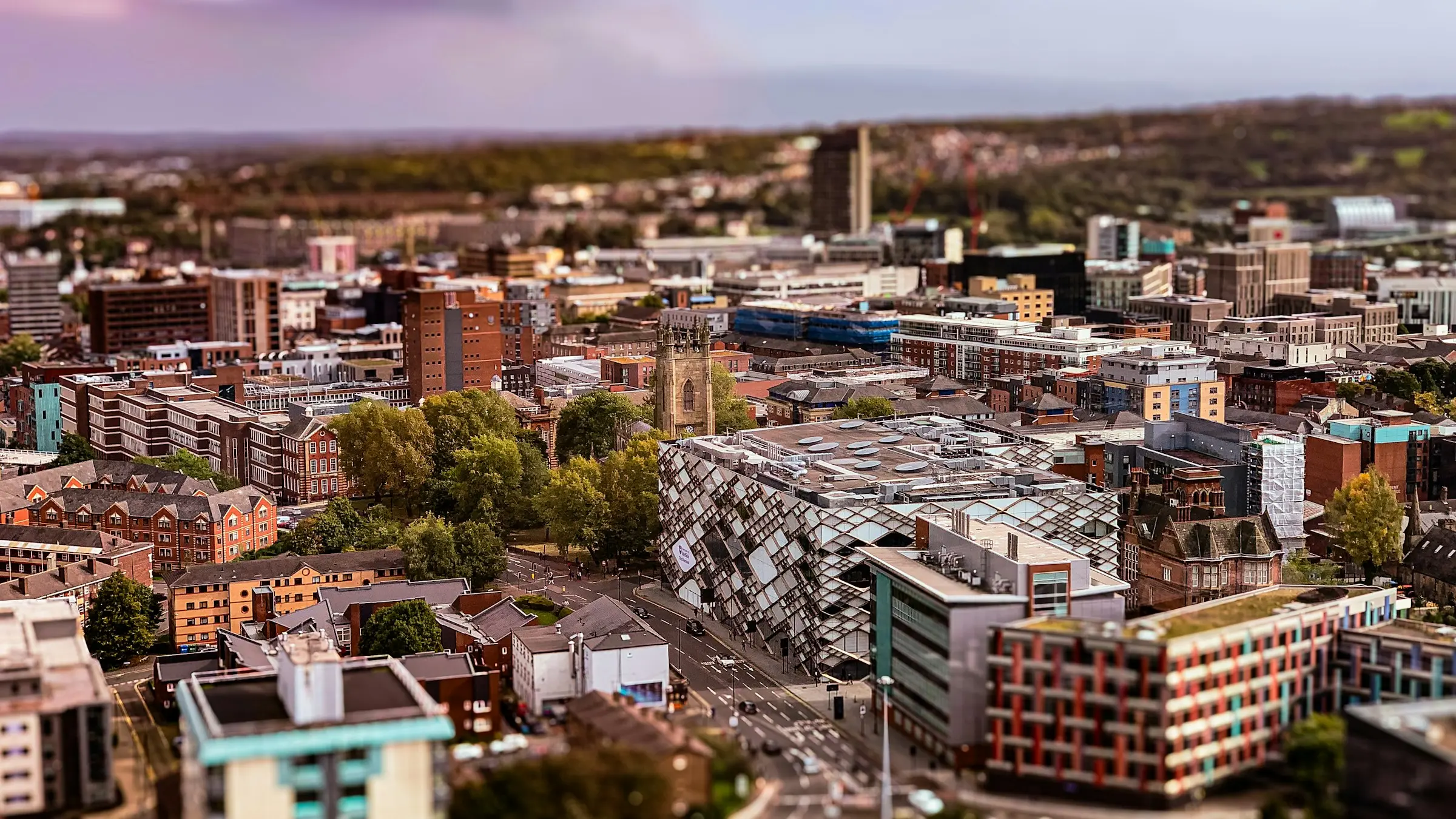
Photograph: Shane Rounce on Unsplash
A timeline of Sheffield
From a manor in the Domesday Book to the trams going back into public hands: the events that made this city what it is, in order, with what happened, why it mattered and where the claim comes from.
Sheffield's story is unusually easy to follow, because it is mostly one story told again and again: a place with fast water and good stone learns to make an edge, gets very good at it, gets rich, gets crowded, gets ill, invents something nobody expected, is bombed for it, loses the industry in a decade, and then has to work out what it is instead. Everything below hangs on that thread.
Where sources disagree about a date or a number, the entry says both rather than picking the tidier answer. Sheffield has plenty of much-repeated stories that nobody can actually source, and those have been left out. If you can source one, tell us and it goes in. Every line links the source it rests on; the eras in the rail will take you to any of them.
1086 to 1499Before the steel
Sheffield begins as a manor in the hills where two rivers meet, on poor farming land with fast water, good stone and iron and charcoal close by. Those are exactly the things you need to make and sharpen blades, and within two centuries of the Domesday survey there is already a man in the tax records known simply as the cutler. The town is small and nobody outside Yorkshire has heard of it, but the trade that will define it for the next seven hundred years has already started.
Sheffield appears in the Domesday Book
The Domesday survey records the manor of Hallam, the land the city now stands on, at the point where the Sheaf runs into the Don.
First written record It is the first time the place is written down at all. Everything on this page is dated forward from here.
A stone castle at the meeting of the rivers
Work on a stone castle began after 1266 and took about four years to finish.
The town gets a centre The castle fixed the town in place and made Sheffield the centre of the lordship of Hallamshire rather than one more village in it.

Sheffield Castle, reconstructed. The stone castle stood where the Sheaf meets the Don until 1648.Gregory Deryckère · Wikimedia Commons · CC BY 2.5 Robert the Cutler pays his tax
The earliest official record of cutlery making in Sheffield is a tax return of 1297 submitted for a man recorded as Robert the Cutler.
The trade arrives early The trade that defined the city for the next six hundred years is already here, named, and paying tax, four centuries before the first steelworks.
Chaucer gives a character a Sheffield blade
By the 1300s Sheffield knives were known well enough outside Yorkshire for Geoffrey Chaucer to put one in The Canterbury Tales.
Known outside Yorkshire A national reputation for one product, earned before the town had a charter, a bank or a made road to anywhere.

What is still standing from before all this
These are the 9 buildings around Sheffield that Wikidata both dates before 1500 and gives a location to, and all but one of them is a church. Two things to hold on to. The dates are as recorded, and a year like 1101 is Wikidata's way of writing "twelfth century" rather than a real year, so read them as rough. And this is what one open database happens to hold rather than a survey of the city: the castle is not on it, because the castle is gone.
- 1101 Beauchief Abbey
- 1101 Church of St Mary the Virgin, Beighton
- 1101 Church of St. Mary, Ecclesfield
- 1101 St Mary's Church, Handsworth, Sheffield
- 1175 Church of St Thomas Becket, Beauchief Abbey
- 1200 Church of St Nicholas
- 1201 Ecclesfield Priory
- 1301 St James' Church, Midhopestones
- 1401 Sheffield Cathedral
1500 to 1739The cutlers take charge
For most of this period Sheffield is a town owned by a lord and run, in practice, by its tradesmen. A queen is held prisoner here for fourteen years, the Civil War takes the castle away, and the cutlers organise themselves into a company with the legal power to set standards and stamp marks on blades. That is the moment the word Sheffield starts to mean something on a piece of steel rather than just somewhere on a map.
Mary, Queen of Scots is held in Sheffield
George Talbot, Earl of Shrewsbury, brought Mary to Sheffield in 1570, and she spent most of the next fourteen years imprisoned in the castle and the manor buildings above it.
A queen under guard For fourteen years a small Yorkshire town held the most closely watched prisoner in England, and the ruins of the manor lodge are still there to walk around.

Mary, Queen of Scots, painted by François Clouet around 1560. She was held in Sheffield for fourteen years.François Clouet · Wikimedia Commons · Public domain The Company of Cutlers in Hallamshire is formed
A company was established to oversee the cutlery trade of the district, set its standards and grant the marks stamped on finished blades. It still exists.
Quality control with teeth Quality control with legal teeth. From this point the word Sheffield on a blade is a claim somebody can be held to, which is the whole basis of the city's reputation.

The Cutlers' Hall on Church Street. The company founded in 1624 is still there, in its third hall on the site.Tim Green · Wikimedia Commons · CC BY 2.0 The castle is slighted
After the Civil War the castle was deliberately demolished, or slighted, so that it could never be held against Parliament again.
The town loses its castle Sheffield lost its fortress and its lordly centre. What grew back on the site was not a great house but a market, and then a town of workshops.


People born here in these years
From Wikidata, which holds the dates. Portraits link to their Wikimedia Commons file page, where the licence and the photographer are recorded. Wikidata knows far more about people born in 1960 than about people born in 1660, so a thin list here is a fact about the record rather than about the century.
 CommonsEdward Talbot 1561 to 1617politician
 CommonsAlethea Howard, Countess of Arundel 1585 to 1654art collector
 CommonsRobert Sanderson 1587 to 1663writer, theologian
- Robert Ludlam 1550 to 1588Catholic priest
- Elisha Kirkall 1682 to 1742visual artist, engraver
- John Balguy 1686 to 1748theologian, philosopher


See the era for yourself
Digitised books, maps and pictures published in these years, from the Internet Archive. Each item states its own rights on its page.
1740 to 1829Crucible steel and Sheffield plate
Within a few years of each other, two men in Sheffield work out how to make a better steel and how to make silverware affordable. Neither is a factory owner and neither sets out to change an industry. What follows is a town that sells not just skill but materials nobody else can make, worked by thousands of self-employed craftsmen renting a bench and a share of a waterwheel. Sheffield grows fast, and almost none of the growth is planned.
Benjamin Huntsman melts steel in a clay pot
Huntsman, a clockmaker working in Handsworth who could not get steel good enough for his springs, developed a crucible process that melted blister steel in a covered clay pot until it ran even.
Steel made to a standard For the first time steel could be made to a consistent quality and cast. Sheffield could now sell a material nobody else could make, not just the skill to shape one.

Teeming, by Robin Bell, which carries the tribute to Huntsman. He was a Quaker and allowed no portrait of himself, so the crucible is his likeness.Malcolm Campbell · Wikimedia Commons · CC BY-SA 2.0 Thomas Boulsover invents Sheffield plate
Boulsover found that a thin sheet of silver could be fused onto a copper ingot and the two rolled out together as one metal.
Silver within ordinary reach Silverware at a price ordinary households could reach. It created an entire second trade in the town beside the knife makers, and a name, Sheffield plate, that outlived the process.

Thomas Boulsover, the cutler who found that silver and copper would roll together as one sheet.Unknown · Wikimedia Commons · Public domain Sheffield gets its own assay office
The town was granted a silver assay office, with the authority to test and hallmark silver made here.
Marking its own silver Silverware no longer had to be carted to London and back to be marked. The city could finish its own work, and keep the margin.
The little mesters
As the trade grew more complex, cutlery firms rented workshops, benches and power to self-employed master craftsmen, each specialising in one stage, whether forging, grinding, hafting or finishing, and in one product, such as razors, penknives or surgical instruments. Mester is the Sheffield word for master.
Thousands of small workshops Sheffield's industry was never one big factory. It was thousands of small ones sharing a roof, which is why the city is full of yards and workshops and why its trade could change what it made almost overnight.

Sheffield in 1736, a few years before Huntsman. This is the town the little mesters worked in.Unknown · Wikimedia Commons · Public domain


People born here in these years
From Wikidata, which holds the dates. Portraits link to their Wikimedia Commons file page, where the licence and the photographer are recorded. Wikidata knows far more about people born in 1960 than about people born in 1660, so a thin list here is a fact about the record rather than about the century.
 CommonsWilliam Staniforth 1740 to 1833surgeon
 CommonsWhite Watson 1760 to 1835sculptor, geologist
 CommonsBernard Howard, 12th Duke of Norfolk 1765 to 1842politician, aristocrat
 CommonsBarbara Hofland 1770 to 1844writer, poet
 CommonsGeorge Bennet 1773 to 1841writer, missionary
 CommonsWilliam Bullock 1773 to 1849writer, naturalist


See the era for yourself
Digitised books, maps and pictures published in these years, from the Internet Archive. Each item states its own rights on its page.
- 1740The Works of John Sheffield: Earl of Mulgrave, Marquis of Normanby, and Duke of Buckingham
- 1784Consideration on the present situation of Great Britain and the United States of America with a view to their future commercial connexions [microform] : containing remarks upon the pamphlet published by Lord Sheffield, entitled, "Observations on the Commerce of the American States;" and also on the Act of Navigation, so far as it relates to those states, interspersed with some observations upon the state of Canada, Nova Scotia, and the fisheries; and upon the connexion of the West Indies with America : together with various accounts, necessary to shew the state of the trade and shipping of both countries
- 1784Considerations on the present situation of Great Britain and the United States of America : with a view to their future commercial connexions. Containing remarks upon the pamphlet published by Lord Sheffield, entitled "Observations on the commerce of the American states;" and also on the act of navigation …
- 1784Considerations on the present situation of Great Britain and the United States of North America, with a view to their future commercial connections [microform] : particularly designed to expose the dangerous tendency of the arguments used, and of the conclusions drawn, in a late pamphlet published by Lord Sheffield, entitled " Observations on the Commerce of the American States;" likewise shewing the advantages, and urging the necessity of relaxing the Act of Navigation in favour of America, both in Great Britain and the West Indies: interspersed with some observations on the state of Canada, Nova Scotia, and the fisheries; and with various accounts necessary to shew the state of the shipping and trade of this country and the United States; as well as of the connection of the latter with the West Indies, previous to the war
1830 to 1899The Victorian city and what it cost
This is the century Sheffield becomes a city, and the century it pays for it. Cholera, a burst reservoir and a decade of violence inside its own trade unions all happen within forty years of each other, and each one ends in an inquiry. It is also the century the city starts building the institutions it still has: a borough council, a college that becomes a university, and, in a field at Highfield, the oldest football club in the world.
Cholera kills 402 people
An epidemic of cholera killed 402 people in Sheffield and infected around a thousand more.
The town outgrows its water It showed how far the water and the housing had fallen behind a town that had been growing faster than anybody was managing it.
The Cholera Monument is completed
A neo-Gothic pinnacle designed by M. E. Hadfield and sculpted by Earp and Hobbs, finished in 1835 on the hillside between Park Hill and Norfolk Park where 339 of the dead were buried. The poet James Montgomery laid the foundation stone. John Blake, the Master Cutler, is the only person named on it.
The poor get a monument A city built on trade chose to commemorate an epidemic that mostly killed the poor, and put the monument where everyone could see it. It is still standing, and the grounds are still open.

The Cholera Monument on Norfolk Road, above the burial ground where the 1832 dead were laid.Graham Hogg · Wikimedia Commons · CC BY-SA 2.0 Sheffield is incorporated as a borough
An Act of Incorporation made Sheffield a municipal borough with an elected council. Our two sources disagree on the year: Wikipedia's article on Sheffield says 1842 and its history of Sheffield says 1843, so treat the exact year as unsettled.
A government of its own The town got a government of its own for the first time, rather than being administered through the lord of the manor and the church.
Bramall Lane
Football stadium.
Sheffield F.C., the oldest football club in the world
Nathaniel Creswick and William Prest founded the club at an inaugural meeting at Parkfield House in Highfield. Their Sheffield Rules, agreed at the 1858 annual meeting and published the year after, were the first detailed rules of football published by a club rather than a school or a university. FIFA recognises Sheffield F.C. as the oldest independent club still playing.
The rules written here The written form of association football was argued out in several places at once, and one of them was here. The club is still going.

Sheffield F.C. at the Coach and Horses, Dronfield. The oldest club in the world has never owned a big ground.Neil Theasby · Wikimedia Commons · CC BY-SA 2.0 The Great Sheffield Flood
The Dale Dyke dam above Low Bradfield failed on the night of Friday 11 March 1864 and the reservoir came down the Loxley and the Don into the town. At least 240 people died, and more than 600 houses were damaged or destroyed. The figure is not settled: the same account gives both 240 and 238. The inquest put the failure down to ground movement under the embankment and found nobody at fault.
The water comes down A reservoir built to supply a fast-growing industrial town destroyed a large part of it in one night, and the inquiry that followed cleared the company that built it.

The breached Dale Dyke embankment, drawn within days of the night of 11 March 1864.Unknown · Wikimedia Commons · Public domain The Sheffield Outrages
A run of explosions, sabotage and, in at least one case, murder, carried out within the grinding and cutlery trades to enforce union membership and union rules. A special commission of inquiry sat in May 1867 and offered witnesses immunity. William Broadhead, secretary of the Saw Grinders' Union, admitted paying two men fifteen pounds to kill the employer James Linley.
A hunt for crimes It produced one of the most detailed accounts of Victorian working life anybody had gathered, and it was conducted almost entirely as a hunt for crimes rather than for causes, a criticism made at the time, in the city, by Isaac Ironside.

The Illustrated Police News of 29 June 1867, reporting the Outrages while the inquiry sat.The Illustrated Police News · Wikimedia Commons · Public domain Firth College opens
Firth College opened in 1879, and in 1897 merged with the city's medical school and technical school to form University College of Sheffield.
A university starts here The first of the three institutions that became the University of Sheffield, founded while the city was still arguing about drains.
Sheffield is granted city status
City status was granted by letters patent in 1893.
The name catches up Formal recognition of what the century had already done: a manor with a knife trade had become one of the industrial centres of the country.

The Town Hall, opened four years after city status and still the council's address.Tim Green · Wikimedia Commons · CC BY 2.0 Hillsborough Stadium
Stadium in Sheffield, England.


What that century did to the size of the place
Sixty thousand people in 1801 and four hundred and fifty thousand by 1901: the cholera, the flood, the outrages and the charter above all happen inside that climb. The series runs past this era so you can see how it ended. The peak is 1951 and the city has never been that big again. The points are not evenly spaced, which is why they are columns and not a line, and the 1941 figure sits where wartime Britain took no census at all.
People born here in these years
From Wikidata, which holds the dates. Portraits link to their Wikimedia Commons file page, where the licence and the photographer are recorded. Wikidata knows far more about people born in 1960 than about people born in 1660, so a thin list here is a fact about the record rather than about the century.
 CommonsNathaniel Creswick 1831 to 1917association football player
 CommonsJohn Carbutt 1832 to 1905businessperson, photographer
 CommonsWilliam Isaac Spencer 1832 to 1897surgeon, naturalist
 CommonsCharles Skelton 1833 to 1913
 CommonsWilliam Newman 1833 to 1903surgeon
 CommonsHarry Wright 1835 to 1895cricketer, baseball player


See the era for yourself
Digitised books, maps and pictures published in these years, from the Internet Archive. Each item states its own rights on its page.
- 1831Remarks on patent vegetable medicated vapour baths, air-pump vapour baths, portable sudatory baths, sulphureous fumigation baths, and cold and tepid shower baths; Portobello, near St. George's Church, Sheffield : including extracts from medical and other authorities, and reports of cases of various diseases, relieved or cured
- 1832Butlers' Commercial List, or Price Book of Articles Manufactured in London, Birmingham, Bristol, Wolverhampton, Sheffield, &c., &c.
- 1833Letter of the Rev. Ralph R. Gurley, on the American Colonization Society; addressed to Henry Ibbottson, esq. of Sheffield, England
- 1833Memoirs of the life, character, and labours of the Rev. John Smith, late of Sheffield
1900 to 1950Stainless steel, and total war
A laboratory in Sheffield looking for a harder gun barrel finds a steel that does not rust, and changes every kitchen and hospital in the world. The same expertise makes the city a target: two nights of bombing in December 1940 kill more Sheffield people than any other event in its history. Between the two, walkers from the industrial cities start trespassing on the moors that the city looks out at, and win.
The University of Sheffield gets its charter
The university charter was sealed on 31 May 1905 and University College of Sheffield became the University of Sheffield.
Teaching the steel it made The city that made the steel now trained the people who studied it, which is how a works laboratory came to be doing original metallurgy eight years later.
Harry Brearley casts a steel that will not rust
Working at the Brown Firth laboratories on the problem of gun barrels wearing out, Brearley cast an alloy of roughly 12.8 per cent chromium and 0.24 per cent carbon and found that it resisted the acid he used to etch samples. The date is not agreed: 13 August 1913 is the usual one, the American Society for Metals dates casting number 1008 to 20 August 1913, and some accounts put the discovery in 1912.
Found while looking elsewhere Stainless steel is now in every kitchen, hospital and chemical plant in the world. It came out of a Sheffield works laboratory that was looking for something else entirely.

Harry Brearley, who was looking for a gun barrel that would not wear and found a steel that would not rust.Unknown · Wikimedia Commons · Public domain Diocese of Sheffield
Church of England diocese.
Orgreave Train Collision 1926
Railway accident in the UK.
The mass trespass of Kinder Scout
Walkers organised by Benny Rothman of the British Workers' Sports Federation deliberately trespassed onto private grouse moor. Six were arrested, five convicted, with sentences of two to six months. How many took part is genuinely unknown: contemporary reports say 100 or 400, the organisers said 600 to 800, and Ewan MacColl remembered over 3,000.
The moors opened up It is the best known moment in the campaign for a right to roam, and the moorland it was about became part of the first national park in Britain nineteen years later.

Bowden Bridge quarry, where the walkers set off in April 1932. Five of them went to prison for it.Marcin Floryan · Wikimedia Commons · CC BY 2.5 The Sheffield Blitz
Two heavy raids three nights apart. On the 12th the alert sounded at 7pm, the pathfinders arrived at 7.41pm and the bombing went on until 4am. Over 660 people were killed, 1,500 injured and 40,000 made homeless; 3,000 homes were demolished and 78,000 damaged. The worst single moment was the Marples Hotel on Fitzalan Square, hit at 11.44pm, where 78 people sheltering in the cellar died.
The worst two nights The city that made the steel for the war was always going to be a target. Nothing else in Sheffield's recorded history killed so many of its people, and the centre people walk through now was built over what those two nights cleared.
Sheffield burning, December 1940. Two nights of raids killed more people here than anything before or since.US National Archives · Wikimedia Commons · Public domain The Peak District becomes Britain's first national park
The Peak District was designated on 17 April 1951 under the National Parks and Access to the Countryside Act 1949, the first national park in the United Kingdom.
The moors become a park About a third of Sheffield lies inside it. An industrial city ended up with a national park inside its own boundary, which is why the buses out of town go to crags and reservoirs.

Mam Tor. The Peak District became Britain's first national park in 1951, nineteen years after the trespass.Evilbish · Wikimedia Commons · CC BY 3.0


People born here in these years
From Wikidata, which holds the dates. Portraits link to their Wikimedia Commons file page, where the licence and the photographer are recorded. Wikidata knows far more about people born in 1960 than about people born in 1660, so a thin list here is a fact about the record rather than about the century.
 CommonsAlbert Ledoux 1901 to 1988diplomat
 CommonsDanny Cummings 1901drummer, percussionist
 CommonsDove-Myer Robinson 1901 to 1989politician
 CommonsHarry Wragg 1902 to 1985horse trainer
 CommonsElina Mottram 1903 to 1996architect
 CommonsThomas Allibone 1903 to 2003physicist


See the era for yourself
Digitised books, maps and pictures published in these years, from the Internet Archive. Each item states its own rights on its page.
- 1900A chat about old China and Sheffield plate [microform]
- 1900Electro-plate, cutlery & sterling silver / Walker & Hall, Manufacturers, Sheffield [trade catalogue] [Variant title: Sterling silver, electro-plate, cutlery, spoons & forks]
- 1900History of Upper Chapel, Sheffield: Founded 1662: Built 1700, a Bicentennial Volume with …
- 1900History of Upper Chapel, Sheffield; founded 1662: built 1700, a bicentennial volume with … Timothy Jollie's Register of baptisms, 1681-1744
1951 to 1995Rebuilding, and the end of the steel age
Sheffield rebuilds itself with real ambition. Streets in the sky at Park Hill, a theatre in the round in the centre. Then, within a single decade, it loses the industry that paid for all of it. The 1980s in this city are a strike, a coking works, a stadium disaster and a shopping centre built on the ground where a steelworks stood. They are also cheap synthesisers, a record label above a shop, and a generation who wrote about all of it.
Park Hill is built
995 flats and maisonettes designed by Jack Lynn and Ivor Smith under the city architect J. L. Womersley, with deck access wide enough to walk along, on the hill above the station. It was listed Grade II* in 1998, at the time the largest listed building in Europe.
Slums rehoused without breaking streets The most ambitious attempt in Britain to rehouse people from back-to-back slums without breaking up the streets they already lived in. Whether it worked is still argued about in the city, loudly.

Park Hill, streets in the sky, from the station side. The rebuilding is still going on block by block.Mr Ignavy · Wikimedia Commons · CC BY-SA 2.0 Drama Studio, University of Sheffield
Theatre in Sheffield, South Yorkshire, England, UK.
The Crucible Theatre opens
A 980-seat thrust stage designed by RHWL with Tanya Moiseiwitsch, in the tradition of Tyrone Guthrie's theatres, replacing the old Sheffield Repertory Theatre.
A stage in the round A city that had lost its repertory theatre built one of the most admired producing houses in the country instead, with a stage the audience sits around rather than in front of.

The Crucible on Tudor Square: a thrust stage with the audience on three sides, which is why the snooker works.BCDS · Wikimedia Commons · CC BY-SA 4.0 The World Snooker Championship comes to the Crucible
The championship was first held at the Crucible in 1977 and has been played there every year since.
A playhouse lends its name A theatre built for drama turned out to be the right room for snooker, and the name of a Sheffield playhouse became the name of a world championship.

The Crucible during the 2024 World Championship, the forty-eighth held in a 980-seat theatre.BennyOnTheLoose · Wikimedia Commons · CC0 The Human League
Formed in Sheffield in 1977 by Ian Craig Marsh and Martyn Ware on synthesisers with Philip Oakey singing. Their album Dare, released in October 1981, went to number one, and Don't You Want Me spent five weeks at number one over that Christmas and sold almost 1.5 million copies in the UK.
Synthesisers in a steel city Cheap synthesisers in a steel city produced a sound that went round the world, and set the pattern for the run of Sheffield bands that followed.

The Human League, still touring. They started in Sheffield in 1977 with cheap synthesisers and no guitars.Andy Mac Giolla Eoin · Wikimedia Commons · CC BY-SA 3.0 The national steel strike
British Steel workers struck over pay from 2 January 1980, the first national steel strike since 1926. It lasted thirteen weeks, spread to the private sector, and ended on 3 April with a 16 per cent rise in exchange for productivity and working-practice changes.
The decade the steel went It opened the decade in which Sheffield's steel employment collapsed. The plants that stayed open after it were, in most cases, much smaller.
Orgreave
During the miners' strike about 5,000 pickets and about 6,000 officers from eighteen police forces, with dogs and 42 mounted officers, met at the Orgreave coking works. 123 people were injured. Seventy-one pickets were charged with riot and 24 with violent disorder; the trials collapsed when police evidence was judged unreliable and every charge was dropped. In 1991 South Yorkshire Police paid £425,000 in compensation to 39 miners. No officer was disciplined.
Still argued over It is still the most disputed day in South Yorkshire's recent history, and the argument about what happened and who should answer for it has never been closed.

Orgreave coking works in 1989. The field beside it is now the Advanced Manufacturing Park.Chris Allen · Wikimedia Commons · CC BY-SA 2.0 National Emergency Services Museum
Museum in Sheffield, England.
The Hillsborough disaster
A crush at the FA Cup semi-final between Liverpool and Nottingham Forest at Hillsborough killed 94 people on the day. The toll reached 97 with the deaths of Tony Bland in 1993 and Andrew Devine in 2021. In 2016 the inquests returned verdicts of unlawful killing and found that errors and omissions by the police, the club, the ambulance service and the stadium design caused or contributed to the deaths, and that the behaviour of supporters did not.
Twenty-seven years to correct It happened in this city, it changed British stadiums permanently, and it took twenty-seven years for the official record to be corrected.

Hillsborough. The Leppings Lane end is on the far side of the ground from this view.Graham Hogg · Wikimedia Commons · CC BY-SA 2.0 Warp Records puts out its first single
Steve Beckett and Rob Mitchell, who worked at the FON record shop on Division Street, refitted it with the producer Robert Gordon as Warp Records. The first release, in 1989, was Track With No Name by Gordon's band Forgemasters, the same name as the city's steelworks.
Electronic music from Division Street One of the most influential electronic labels in the world started in a record shop in the middle of Sheffield, in the same decade the works were closing.
Meadowhall opens on a steelworks site
The shopping centre opened on 4 September 1990, built on the site of Hadfields' East Hecla steelworks, with a floor area of about 139,355 square metres.
Retail on the steelworks floor Nothing states what happened to the Lower Don Valley more plainly than a million and a half square feet of retail standing where Hadfields made steel.

Meadowhall, built on the cleared ground of the Hadfields steelworks in the lower Don valley.Paul Harrop · Wikimedia Commons · CC BY-SA 2.0 FlyDSA Arena
Arena in Sheffield, South Yorkshire, England.
Sheffield Hallam University
Sheffield City Polytechnic became Sheffield Hallam University with the right to award its own degrees. Its line runs back to the Sheffield School of Design, founded in 1843 after lobbying by the artist Benjamin Haydon.
Two universities at last The city had two universities for the first time, a hundred and fifty years after the first of the institutions behind them opened its doors.
The Supertram starts running
The first section opened on 21 March 1994, running out to Meadowhall along a former heavy rail alignment. The network was completed in stages, with the last main section, Shalesmoor to Middlewood and Malin Bridge, opening on 23 October 1995.
Trams return to the streets Trams came back to Sheffield streets after decades away, and the first line went to the shopping centre that had replaced the steelworks.

A Supertram at Meadowhall interchange, on the first stretch of the network to open in 1994.Secretlondon · Wikimedia Commons · CC BY-SA 4.0 Pulp release Different Class
The album entered the UK chart at number one and won the 1996 Mercury Music Prize. Pulp had been going in Sheffield since 1978.
Seventeen years to be heard A record about class, sex and where you go when you have no money, made by a band who had spent seventeen years in the city getting nowhere first.

Pulp, back on stage in 2023. Different Class came out twenty-eight years earlier.Raph_PH · Wikimedia Commons · CC BY 2.0


What happened to the steel jobs
These are national numbers, from the Office for National Statistics, not Sheffield ones. The shape is the point: more than half the industry went between 1978 and 1981, which is the decade on this page. A Sheffield-only figure for the same years is quoted everywhere and sourced almost nowhere, so it is not on this chart.
While the works closed, the buildings were being listed
This counts the decade each building was protected, not the decade it was built. The tall column is the 1980s, the same decade as the strike, Orgreave and the closures on this page: as the industry went, what was left around it started being listed, and almost all of it at grade II. The snapshot covers a box around Sheffield that also takes in edges of Rotherham, Barnsley and north Derbyshire. Scheduled monuments and registered parks and gardens are now held with their own designation dates, and so are the remaining National Heritage List designations, but they are not stacked here because neither a monument nor a battlefield carries a building grade, and because Sheffield turns out to have no registered battlefields, protected wreck sites or World Heritage Sites at all.
| Decade listed | Grade II | Grade II* | Grade I |
|---|---|---|---|
| 1950s | 70 entries | 30 entries | 16 entries |
| 1960s | 515 entries | 103 entries | 40 entries |
| 1970s | 373 entries | 13 entries | 1 entries |
| 1980s | 1835 entries | 35 entries | 8 entries |
| 1990s | 138 entries | 1 entries | 0 entries |
| 2000s | 37 entries | 1 entries | 0 entries |
| 2010s | 34 entries | 0 entries | 0 entries |
| 2020s | 15 entries | 2 entries | 0 entries |
People born here in these years
From Wikidata, which holds the dates. Portraits link to their Wikimedia Commons file page, where the licence and the photographer are recorded. Wikidata knows far more about people born in 1960 than about people born in 1660, so a thin list here is a fact about the record rather than about the century.
 CommonsMartin Elliott 1951surgeon
 CommonsPaul Carrack 1951musician, composer
 CommonsPhilip John Burgan 1951racing automobile driver, chief executive officer
 CommonsSteve Dawson 1951musician, composer
 CommonsChris Watson 1952musician, painter
 CommonsGeoff Nicholson 1953 to 2025writer, novelist


See the era for yourself
Digitised books, maps and pictures published in these years, from the Internet Archive. Each item states its own rights on its page.
1996 to todayThe city since
What replaced the steelworks was not one thing. Two universities, a research centre for Boeing and Rolls-Royce on the field where the pickets stood at Orgreave, a glasshouse in the middle of town, a band from High Green with the fastest-selling debut album in British chart history, and the slow rebuilding of Park Hill in public, one block at a time. The arguments about what the city should be are not settled, which is roughly how it has always been here.
The Advanced Manufacturing Research Centre opens at Orgreave
The University of Sheffield founded the AMRC in 2001 with Boeing, on the reclaimed site of the former Orgreave coking works. Rolls-Royce, McLaren and others have since built on the same park.
Research on the picket field The ground where 5,000 pickets and 6,000 police met in 1984 is now where the region does its advanced manufacturing research. There is no neater illustration of what changed.

The Advanced Manufacturing Park at Catcliffe, on the ground where the Orgreave pickets stood.Chemical Engineer · Wikimedia Commons · CC BY-SA 4.0 The Winter Garden opens
A glasshouse 70 metres long and 21 metres high, built of glued laminated larch by Pringle Richards Sharratt with Buro Happold as part of the Heart of the City scheme, holding more than 2,000 plants. It was opened by Elizabeth II.
A glasshouse free to enter A temperate glasshouse in the middle of the city centre that anybody can walk through, for nothing, on the way to somewhere else.

The Winter Garden: larch arches, a public right of way through the middle, and no admission charge.Mr Ignavy · Wikimedia Commons · CC BY-SA 2.0 Arctic Monkeys' debut album
Whatever People Say I Am, That's What I'm Not sold 363,735 copies in its first UK week, more than the rest of the top twenty put together, and became the fastest-selling debut album in British chart history.
Taxi ranks and chart records The songs are about taxi ranks, nightclub queues and High Green, and the record they were on broke a national chart record. The city had been writing about itself for thirty years by then.

Arctic Monkeys at Roskilde in 2014, eight years after the fastest-selling debut album in British chart history.Bill Ebbesen · Wikimedia Commons · CC BY 3.0 Park Hill is rebuilt in public
Urban Splash began regenerating the listed estate in 2006, in five phases, and the work is still going on.
An argument built in public The argument about whether Park Hill should have been saved has been running since the 1998 listing, and the answer is being built one block at a time where everybody can see it.

Kelham Island Museum, on an island cut for a mill race, a few minutes from the rebuilt Park Hill.BCDS · Wikimedia Commons · CC BY-SA 4.0 Wheel of Sheffield
Ferris wheel in Sheffield, England.
Sheffield Student Housing Co-operative
Student housing co-operative in Sheffield, England.
The Supertram returns to public ownership
Operation transferred from Stagecoach to South Yorkshire Future Trams Limited on 22 March 2024, thirty years after the first tram ran.
Back into public hands The network went back into public hands almost exactly three decades after it opened, which is the sort of full circle this city specialises in.

Sheffield now. Two universities, a tram network back in public hands, and the moors on three sides.Nbfreeh · Wikimedia Commons · CC BY-SA 4.0


What the tram actually carries
Supertram has been running since 1994 and went back into public hands in 2024, and at the 2021 census 2,965 of the city's 256,037 workers used it to get to work. That is the honest scale of it next to the car. One large caveat: this census was taken in March 2021, under covid restrictions, so the home-working slice is far bigger than a normal year and every travelling slice is smaller. It is a snapshot of one strange spring, not of how Sheffield usually moves.
| Way of getting to work | Workers aged 16 and over |
|---|---|
| Driving | 115230 workers |
| Working from home | 73974 workers |
| Walking | 22076 workers |
| Bus | 18921 workers |
| Car passenger | 11029 workers |
| Cycling | 3739 workers |
| Taxi | 2995 workers |
| Tram | 2965 workers |
| Other | 2610 workers |
| Train | 1857 workers |
| Motorbike | 641 workers |
People born here in these years
From Wikidata, which holds the dates. Portraits link to their Wikimedia Commons file page, where the licence and the photographer are recorded. Wikidata knows far more about people born in 1960 than about people born in 1660, so a thin list here is a fact about the record rather than about the century.
 CommonsAlex Kiwomya 1996association football player
 CommonsGia Ford 1996singer-songwriter
 CommonsTim Rouse 1996cricketer
 CommonsCurtis Morrison 1997association football player
 CommonsDominic Calvert-Lewin 1997association football player
 CommonsJoey Walker 1997sport cyclist


