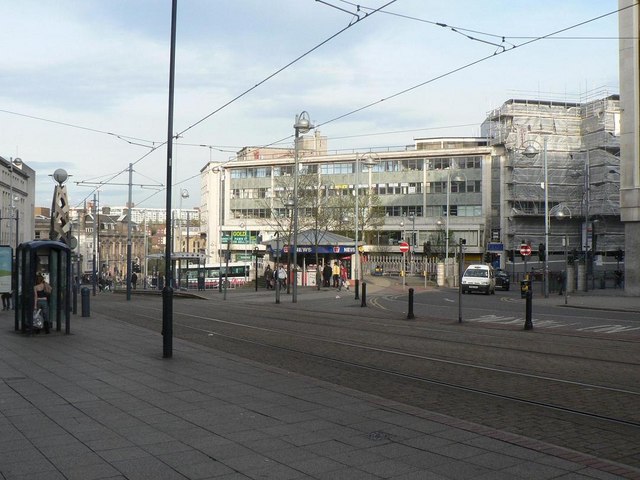
Cover photograph: Castle Square in 2008, after the Hole in the Road was filled in. Photo: Chris Downer / Geograph, CC BY-SA 2.0.
Last updated: 24 October 2026.
If somebody in Sheffield says they met by the fish tank, they might mean the Hole in the Road. The circular sunken pedestrian space at Castle Square opened in 1967 and was filled in during the 1990s as the Supertram route changed the city centre. Its official name never displaced the name people gave it. The place was an underpass, a set of small shops, a shortcut and, for many, a meeting point. The fish tank made it memorable in a way few traffic schemes ever become.
What was actually there?
Picture Sheffield has a 1968 council photograph of Castle Square, credited to the City Engineer and Surveyor. You can see the sunken centre and the roads around it. Other photographs in the archive show the escalators, shops and people using the space. Link through to those records rather than lifting an archive image: the council’s collection has reuse conditions, and the photographs deserve their own proper captions and references.
The planning idea was of its time. Put cars on the surface, move pedestrians below and connect the shopping streets at a lower level. From above it was a roundabout; from below it was a little public room open to the sky. The space had kiosks and basement entrances as well as the tank. That is why calling it merely a subway misses the point. People did not only pass through; they arranged to meet there.
Step inside through the photographs
These four photographs show the Hole in the Road from pedestrian level, not just the roundabout above it. Open each original record to see the image and its archive details:
- Castle Square from inside, 1977. Photograph: Pete Hill / Picture Sheffield, reference ph00582.
- The shops in the sunken precinct, c.1970s. Photograph: Pete Hill / Picture Sheffield, reference ph00583.
- Another view of the Castle Square shops, c.1970s. Photograph: Pete Hill / Picture Sheffield, reference ph00584.
- The staircase down to Castle Square, 1977. Photograph: Pete Hill / Picture Sheffield, reference ph00585.
Picture Sheffield lists Pete Hill as the copyright holder for these archive images, so the links take you to its original records. The photographs make the scale of the lower level, its shops and its entrances much clearer than a present-day view can.
The fish tank and the stories around it
The aquarium in the wall became the natural landmark. Ask a group of Sheffielders what they remember and you will hear about the fish almost immediately. It gave a practical meeting instruction: wait by the tank. The detail matters because it turns a concrete crossing into somewhere with a shared memory. A first date, a shopping trip or a child’s stop to stare at the fish can outlast the road layout in a way a planner’s drawing cannot.
Some stories about what happened to the fish after closure are repeated with great confidence. The sources do not all agree, and a memorable tale is not the same as a documented account. A local history piece is better when it keeps that distinction. The archive photographs prove the place and its use; recollections tell us what it felt like to be there. Both are worth keeping, with their labels attached.
Why it went
The square’s later reputation was mixed. People remember the fish tank and the meeting point, but others remember a grubby or uncomfortable route. Nostalgia is not a reason to flatten that difference. Supertram construction made a new surface layout possible, and the Hole in the Road was closed and filled in during 1994. The current Castle Square stop and public space sit over the old arrangement. Local historian Mike Higginbottom explains the transport and planning context, while Picture Sheffield lets you compare scenes from different years.
Find it without expecting a replica
Stand at Castle Square today and look between High Street, Arundel Gate and Commercial Street. There is no doorway down to the tank. The useful exercise is to compare the archive view with the street in front of you: which routes survive, which corners have changed, and where would you have waited for a friend? The answer is more interesting than a claim that old Sheffield was simply better or worse.
Sheffield’s Local Studies Library holds the city’s large photographic collection and can help with deeper research. Its Picture Sheffield records include image references and rights information. Our city-centre what's on calendar makes it easy to pair a short history stop with something happening now. If you have your own memory of the Hole in the Road, keep the details: when you went, what you saw, and what you can actually verify. That is how a local story stays useful after the place itself has gone.